Key Takeaways
- 1VO2 max is a stronger predictor of mortality risk than cholesterol, blood pressure, or smoking status according to a 122,000-patient Cleveland Clinic study.
- 2Each 3.5 ml/kg/min increase in VO2 max is associated with a 13% reduction in all-cause mortality, with meaningful gains achievable within 8-12 weeks.
- 3Zone 2 aerobic training at 150-200 minutes per week builds the mitochondrial and cardiovascular base essential for VO2 max improvement.
- 4One weekly HIIT session using 4-minute intervals at 90-95% max heart rate produces VO2 max gains comparable to steady-state training in one-third the time.
Introduction: The Metric That Matters More Than You Think
You probably know your cholesterol number. You might track your blood pressure. But do you know your VO2 max?
You should. In 2023, a landmark study published in JAMA from Cleveland Clinic researchers found something striking: cardiorespiratory fitness—measured as maximal oxygen uptake, or VO2 max—was a stronger predictor of mortality risk than virtually any other clinical marker, including cholesterol levels, blood pressure, smoking status, and diabetes.
This isn't fringe science or a finding that contradicts decades of medical wisdom. Rather, it crystallizes something exercise physiologists have understood for years: how efficiently your body uses oxygen is fundamentally linked to how long you'll live.
Peter Attia, the longevity-focused physician and researcher, has called VO2 max "the most powerful modifiable risk factor for living longer." That's a bold claim, but the evidence supports it. The question is: What exactly is VO2 max, why does it matter so much, and what can you actually do to improve yours?
What Is VO2 Max, and Why Does It Matter?
VO2 max is the maximum amount of oxygen your body can utilize during intense exercise, measured in milliliters of oxygen per kilogram of body weight per minute (ml/kg/min). Think of it as your aerobic engine's horsepower—a direct measure of your cardiovascular and respiratory system's capacity to deliver oxygen to muscles, and your muscles' ability to extract and use that oxygen.
Here's the mechanism: During exercise, your heart pumps blood to your muscles, your lungs extract oxygen from the air, and your muscles burn that oxygen to produce energy. The more oxygen your body can process at maximal effort, the more work you can do. Your VO2 max reflects the efficiency of this entire chain.
But why is this linked to longevity? Several factors:
Cardiovascular Health: VO2 max is fundamentally a measure of heart and lung function. Higher aerobic capacity is associated with better endothelial function (the lining of blood vessels), lower resting heart rate, and reduced arterial stiffness—all markers of cardiovascular health.
Metabolic Resilience: People with higher VO2 max tend to have better insulin sensitivity, more favorable lipid profiles, and lower systemic inflammation. These are all independent risk factors for chronic disease.
Muscle and Mitochondrial Function: VO2 max depends on having robust mitochondria—the cellular powerhouses. Mitochondrial decline is implicated in aging itself; maintaining VO2 max means maintaining mitochondrial capacity.
Brain Health: Some emerging evidence suggests that aerobic fitness is linked to cognitive function and potentially lower dementia risk, possibly through improved cerebral blood flow and reduced neuroinflammation.
The Evidence: What the Research Actually Shows
The Cleveland Clinic study, led by Wael Al-Saady and colleagues, analyzed over 122,000 patients who underwent treadmill stress testing. The findings were unambiguous: each 1 MET (metabolic equivalent) increase in cardiorespiratory fitness was associated with a 15% reduction in mortality risk, regardless of age, sex, or other risk factors. In practical terms, moving from the lowest fitness quartile to the highest was associated with a reduction in 10-year mortality risk of nearly 35%.
To contextualize this: improvements in cholesterol or blood pressure—interventions that dominate modern medicine—typically show mortality reductions in the 10-20% range. VO2 max exceeded them significantly.
This builds on decades of population research. The Norwegian HUNT Study, which followed over 230,000 people for more than two decades, found that cardiorespiratory fitness was a more powerful predictor of mortality than traditional risk factors. The Aerobics Center Longitudinal Study, involving over 66,000 participants, showed the same pattern: fitness was inversely correlated with all-cause mortality, independent of body composition, resting heart rate, or blood pressure.
Crucially, these weren't just correlational findings. Intervention studies—where people actually improved their fitness—showed mortality benefits. A 2016 meta-analysis in JAMA found that each 3.5 ml/kg/min increase in VO2 max was associated with a 13% reduction in mortality. And the improvements came relatively quickly; studies show meaningful changes in VO2 max within 8-12 weeks of consistent training.
How Fitness Declines With Age—And What You Can Do About It
Here's the challenging reality: VO2 max naturally declines with age. In sedentary people, it drops approximately 10% per decade after age 30, accelerating after 65. A 70-year-old sedentary person might have a VO2 max around 15-18 ml/kg/min. By contrast, active 70-year-olds can maintain levels of 30-40 ml/kg/min.
But—and this is critical—the decline isn't inevitable. Training can slow it dramatically or even reverse it in the short term.
The decline in VO2 max with age is driven by several factors: decreased maximal heart rate, reduced cardiac output, mitochondrial decline, decreased muscle mass and capillary density, and yes, reduced training stimulus. The good news is that training addresses most of these. Even people in their 70s and 80s show meaningful improvements in VO2 max with appropriate training.
How to Measure Your VO2 Max
There are several ways to measure VO2 max, ranging from precise laboratory testing to field estimates.
Gold Standard: Maximal Exercise Testing
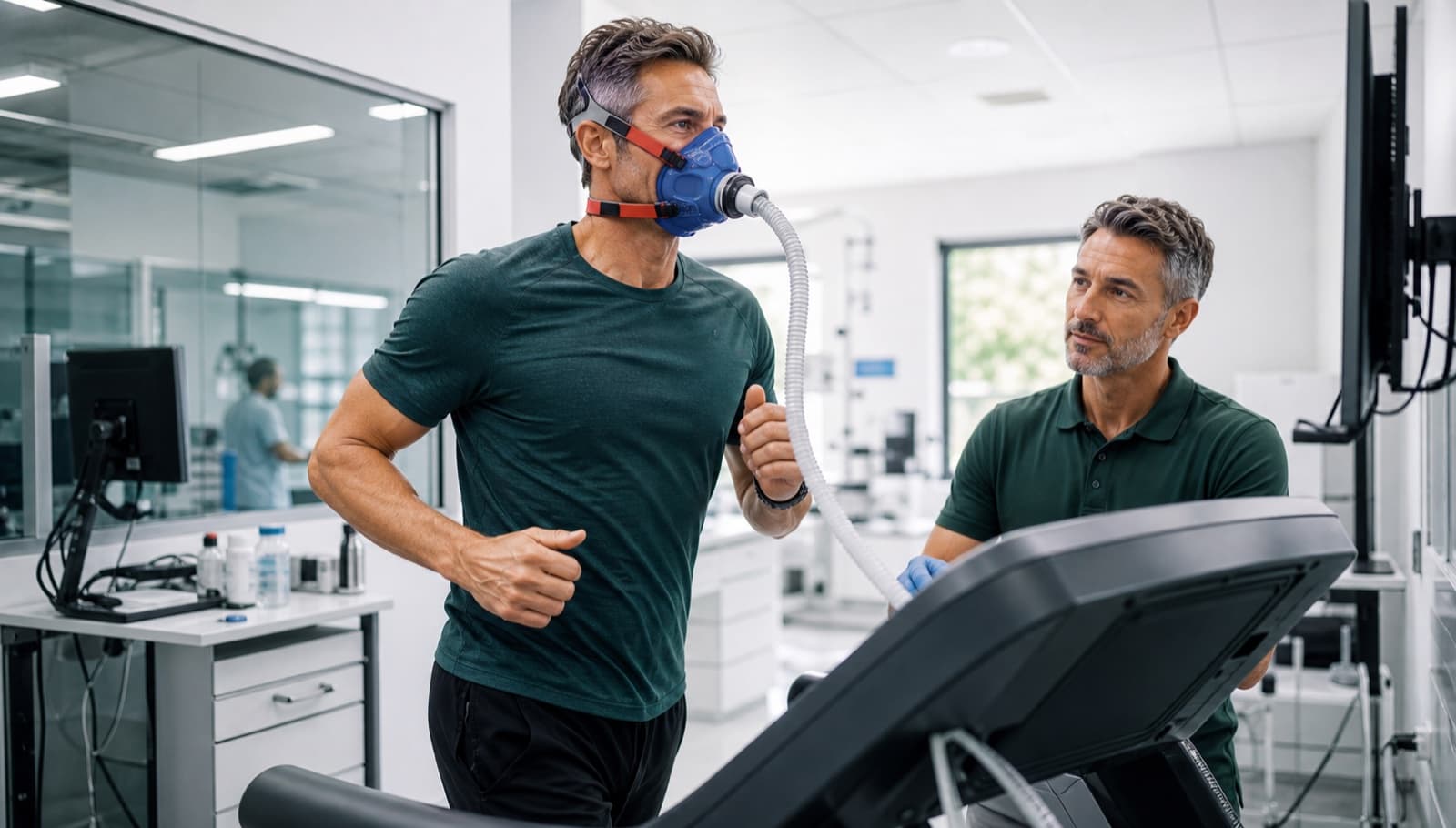
Performed in a laboratory or clinical setting, this involves breathing into a metabolic cart while exercising on a treadmill or stationary bike at increasing intensities until you reach maximal effort. This is accurate but time-consuming, expensive ($200-400+), and requires medical clearance in some cases.
Submaximal Testing
Less demanding alternatives include submaximal treadmill tests or graded exercise protocols that estimate VO2 max from heart rate response. These are more accessible but less accurate (typically ±10-15% error).
Field Tests
The 12-minute run test or 1.5-mile run test estimate VO2 max based on distance covered in a set time. Simple and free, but require all-out effort and some fitness baseline.
Wearable Estimation
Some fitness watches and smartwatches (Garmin, Apple Watch with certain apps) estimate VO2 max from heart rate variability and exercise data. These are convenient but not validated against laboratory standards; treat them as tracking tools rather than precise measurements.
Starting Point: If you haven't had recent fitness testing, a reasonable starting point is a submaximal graded exercise test through your doctor or a local fitness center. Many can estimate your VO2 max reliably without maximal effort. Or simply do a 12-minute run test and use an online calculator—not perfect, but directionally useful.
Training to Improve VO2 Max: The Evidence-Based Approach
The good news: VO2 max is genuinely trainable. Two primary approaches dominate the research:
Zone 2 Aerobic Training
Zone 2 refers to aerobic work at approximately 60-70% of your maximal heart rate—conversational pace, where you can speak but not sing. This might sound easy, and it's certainly not flashy, but it's foundational for VO2 max improvement.
Zone 2 training:
- Builds aerobic base and mitochondrial density
- Improves fat oxidation and metabolic flexibility
- Is sustainable and carries low injury risk
- Enhances cardiac output and stroke volume
The protocol: 150-200 minutes per week of Zone 2 work, performed most days. This can be brisk walking, easy running, steady cycling, or rowing. The key is consistency over months. Many endurance athletes spend 80% of their training time in Zone 2 for exactly this reason.
Research support comes from work by Soren Holmberg (Lund University) and others showing that extensive Zone 2 work produces robust improvements in VO2 max, particularly when volume accumulates. Even in middle-aged and older adults, 12-16 weeks of Zone 2 training produces 10-20% VO2 max improvements.
High-Intensity Interval Training (HIIT)
The other pillar is HIIT: brief, maximum-effort work intervals separated by recovery. Classic protocols include 4-minute intervals at 90-95% maximal heart rate, repeated 4-6 times with 3-minute recovery between.
HIIT is remarkably time-efficient. A meta-analysis by Astrid Zachner and colleagues found that HIIT produced VO2 max gains comparable to steady-state training in roughly one-third the time. However, HIIT carries higher cardiovascular stress and requires better fitness baseline.
Effective HIIT protocols for VO2 max:
- 4x4 method: 4 minutes at 90-95% max HR, 3 minutes easy recovery, repeat 4 times (roughly 30 minutes total including warmup/cooldown)
- 30/30 intervals: 30 seconds all-out effort, 30 seconds recovery, repeat 10-15 times
- Tabata-style: 20 seconds maximal effort, 10 seconds recovery, repeat 8 times (though evidence for this specific protocol is overstated)
Start with one HIIT session per week. More frequent HIIT increases injury risk without proportional benefit.
Practical Programming
A realistic VO2 max training approach:
- 3-4 days per week: Zone 2 aerobic work (120-150 minutes total)
- 1 day per week: HIIT session (one of the above protocols)
- 1-2 days: Strength training or complete rest
This is sustainable, evidence-supported, and doesn't require becoming an endurance athlete.
Timeline: Expect meaningful improvements (5-10% VO2 max gain) within 8-12 weeks. Larger improvements (15-25%) typically take 16-24 weeks of consistent training.
Special Considerations and Context
Age isn't destiny. VO2 max decline is largely training-dependent, not age-dependent. Research on master athletes (45+) shows that those who maintain consistent training preserve VO2 max at levels comparable to untrained 20-year-olds. Start training, and start now.
Baseline matters. If you're sedentary, even modest improvements in VO2 max convey enormous mortality benefits. Moving from the lowest fitness quartile to the second-lowest produces greater absolute mortality reduction than moving from high to elite fitness. You don't need to become a runner.
VO2 max is one piece. While VO2 max is powerfully predictive, longevity requires addressing smoking, alcohol, sleep, stress, nutrition, and strength. VO2 max is a key lever, not the entire lever.
Medical clearance: Before beginning HIIT or maximal stress testing, discuss with your physician, particularly if you have cardiovascular risk factors, are over 50, or have been sedentary.
The Bottom Line
VO2 max is a genuinely modifiable predictor of longevity. The Cleveland Clinic and HUNT studies show it rivals or exceeds traditional risk factors. It's testable, trainable, and the improvements appear to translate directly to mortality benefits.
A practical approach: assess your current fitness baseline (even roughly), commit to 150+ minutes of Zone 2 aerobic work per week, add one HIIT session weekly, and retest in 12 weeks. You'll likely see meaningful improvements in VO2 max and, more importantly, in the biological markers that predict how long you'll live.
In the context of longevity medicine, VO2 max deserves its reputation. It's the single best modifiable marker of your aerobic engine—and your aerobic engine is, in many ways, your life expectancy engine.
Source notes
References
4 cited sources
- 1Mandsager, K. et al. (2018). Association of cardiorespiratory fitness with long-term mortality among adults undergoing exercise treadmill testing. JAMA Network Open.
- 2Nes, B. M. et al. (2014). The HUNT Study: Fitness tracking and all-cause mortality in a Norwegian population. Medicine and Science in Sports and Exercise.
- 3Kodama, S. et al. (2009). Cardiorespiratory fitness as a quantitative predictor of all-cause mortality: a meta-analysis. JAMA, 301(19), 2024-2035.
- 4Attia, P. (2023). Outlive: The Science and Art of Longevity. Harmony Books.